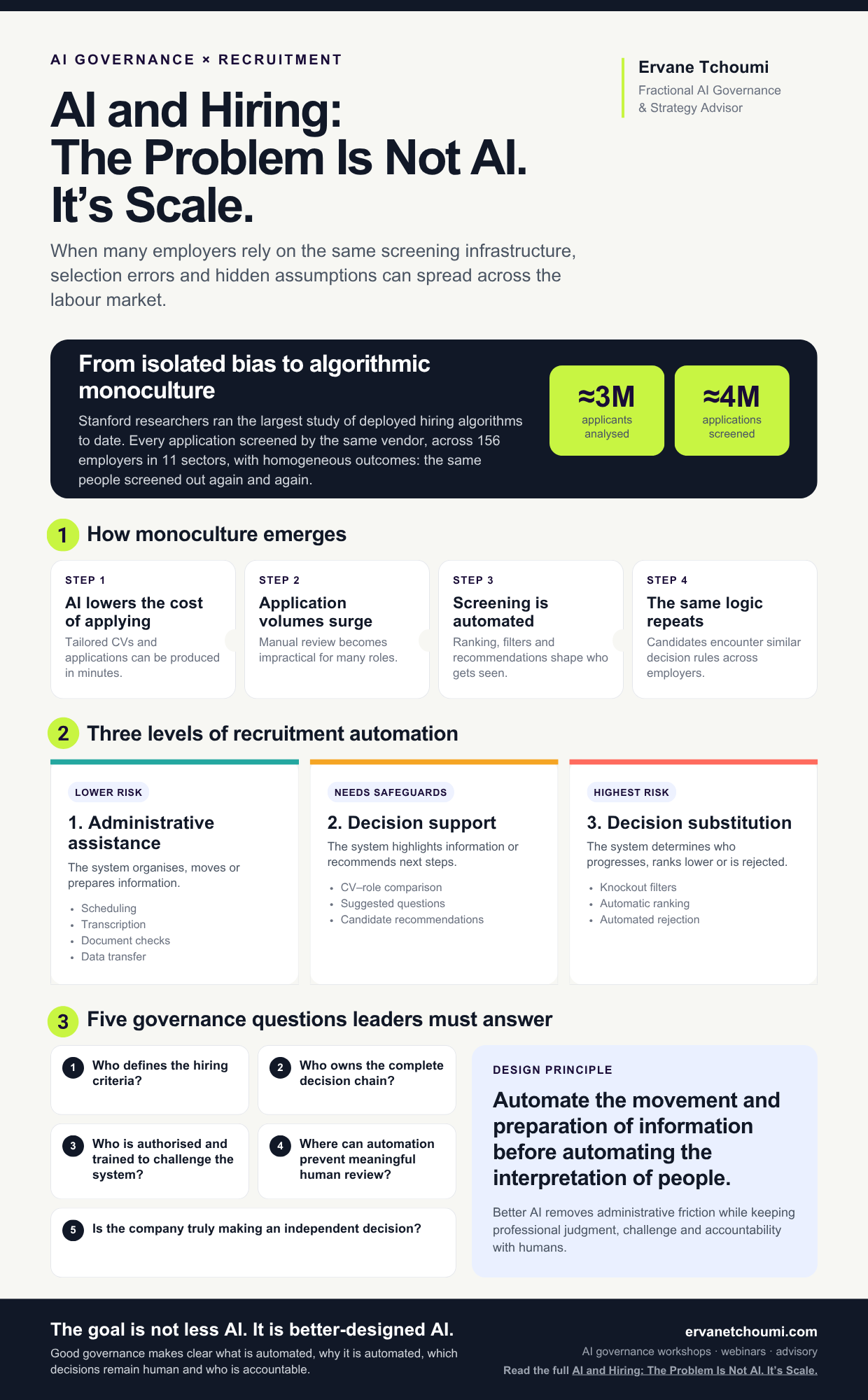
AI and Hiring: The Problem Is Not AI. It's Scale.
The Stanford paper Algorithmic Monoculture in Hiring is interesting not because it says AI is biased. We've known that for years. What's more interesting is the concept of algorithmic monoculture.
The researchers analyzed 3.4 million applicants submitting 4 million applications to 156 employers across 11 market sectors, all screened by algorithms provided by the same vendor. It is the largest empirical analysis of deployed algorithmic hiring to date. What they found should make employers, regulators, AI vendors, and governance professionals pay attention.
Rishi Bommasani, Sarah H. Bana, Kathleen A. Creel, Dan Jurafsky and Percy Liang, Algorithmic Monocultures in Hiring. Stanford University, Chapman University and Northeastern University, presented at ACM FAccT 2026. Read the paper
They found evidence of homogeneous outcomes, where the same individuals repeatedly received similar screening outcomes across positions.
Their argument is that when many employers depend on the same hiring systems, the risk is no longer isolated algorithmic bias. The risk becomes algorithmic monoculture.
In practical terms, this means that large employers may increasingly evaluate candidates using the same underlying screening tools, ranking mechanisms, and similar optimization criteria. As a result, candidates may repeatedly encounter the same decision logic across multiple employers.
A rejection is no longer necessarily the result of one company's assessment. It may be the result of repeatedly passing through the same algorithmic filters across the market.
This is what makes the phenomenon systemic rather than organizational.
In other words: a candidate may not be rejected by one company. They may be rejected by the hiring ecosystem.
One of the most striking findings in the paper is that some applicants would need to apply extremely broadly simply to increase the chance that a human ever reviews their application.
Let that sink in for a moment.
Not because a recruiter reviewed their profile and decided against them, but because they repeatedly encounter the same underlying decision infrastructure.
The obvious reaction might be to question the use of AI in hiring altogether. That would miss the point.
Today, employers are not introducing these tools because they want to replace recruiters. They are introducing them because they increasingly have little choice.
Generative AI has dramatically reduced the cost of applying. Candidates can now generate tailored CVs, cover letters, and applications in minutes. The result is a surge in application volumes.
Several recruiting platforms have reported application growth exceeding 200% since the widespread adoption of generative AI. Other market data shows applications per hire increasing sharply across industries.
When hundreds or thousands of applications arrive for a single role, manual review simply does not scale. Automation becomes inevitable.
The question therefore is no longer: "Should companies use AI for screening?" For many organizations, that question has already been answered by reality.
The more important question is: Who defines, owns, and challenges the decision chains that increasingly shape access to opportunity?
Answering that question requires a distinction that is often missing from discussions about AI in hiring. The important distinction is between:
- automating recruitment work;
- supporting recruitment judgment;
- replacing recruitment judgment.
These are three very different uses of AI, with very different consequences.
Automating recruitment work
A significant part of recruitment consists of moving, structuring and preparing information. Recruiters take notes during interviews. They transfer candidate data between email, an applicant tracking system, a CRM and internal databases. They prepare candidate profiles, schedule interviews, collect documents, update clients and answer recurring questions.
These tasks consume time, but they are not necessarily where recruiters create the greatest value.
A recruiter does not assess a candidate more accurately because they manually copy information from interview notes into a profile. A recruitment consultant does not create a better candidate experience by entering the same information into three different systems. A client does not receive a better service because a recruiter needs two days to prepare an update that could have been drafted in minutes and reviewed before being sent.
This is where AI and automation can create immediate value. They can help with:
- interview transcription;
- structured interview notes;
- first drafts of candidate profiles;
- scheduling and reminders;
- document collection;
- detection of missing information;
- CRM and applicant-tracking-system updates;
- internal and client-facing reporting;
- candidate status communication;
- retrieval of relevant candidates from an existing database.
Not all of this requires AI. Modern applicant-tracking systems already support functions such as interview scheduling, reminders, stage transitions, templated communication and calendar synchronisation. AI becomes particularly useful where the process contains unstructured information: converting an interview transcript into structured notes, drafting a candidate profile, extracting documented evidence against role requirements, identifying missing information or retrieving relevant candidates from a large existing database. The design question is therefore not simply where AI can be added. It is which steps require conventional workflow automation, which require language interpretation, and which must remain matters of professional judgment.
In these cases, AI supports the recruiter by reducing administrative friction. The recruiter remains responsible for interpretation, evaluation and communication.
A useful principle is: automate the movement and preparation of information before automating the interpretation of people.
When administration becomes judgment
The boundary is not always obvious.
Summarising an interview may appear administrative. But deciding which statements deserve emphasis already involves interpretation. Matching a CV with a job description may appear technical. But deciding that one type of experience is more valuable than another is a judgment.
Checking whether an application is complete is administrative. Deciding that an incomplete field indicates low motivation is not.
This is why organizations need to distinguish between three levels of automation.
Level 1: Administrative assistance
The system organizes, transfers or prepares information. Examples include:
- scheduling interviews;
- transcribing conversations;
- classifying documents;
- detecting missing files;
- generating reminders;
- transferring data between systems.
The main risks here are accuracy, confidentiality, data protection and inappropriate access. These risks are important, but they can generally be managed through permissions, review processes and clear retention rules.
Level 2: Decision support
The system highlights information or recommends possible next steps. It may:
- identify qualifications mentioned in a CV;
- compare documented experience with job requirements;
- suggest interview questions;
- flag inconsistencies;
- identify areas that require clarification;
- recommend candidates for further review.
At this level, the system is no longer merely moving information. It is influencing how the recruiter sees the candidate.
The risk is not only that the recommendation is wrong. It is that the recruiter begins to accept the recommendation automatically. A system can formally remain "advisory" while becoming decisive in practice.
A human approval button does not guarantee meaningful human oversight when the recruiter lacks the time, information, training or authority to challenge the recommendation.
Level 3: Decision substitution
The system determines who progresses, who is ranked lower or who is rejected. Examples include:
- automatic candidate ranking;
- knockout filters;
- predicted performance scores;
- automatic rejection;
- automated allocation of human review;
- systems that determine which candidates a recruiter sees first, or sees at all.
This is the point at which AI directly shapes access to employment. It is also where the risk of algorithmic monoculture becomes most serious.
When many employers rely on the same vendors, models, ranking mechanisms or optimization criteria, they may believe they are making independent hiring decisions while repeatedly applying the same underlying logic.
The question is no longer only whether one employer's system is biased. It becomes whether the market is reproducing the same selection pattern across many employers.
Candidate experience is more than faster communication
Organizations often describe candidate experience in terms of convenience: shorter forms, faster responses, easier scheduling, personalised emails, automated updates.
All of these can improve the process. But candidate experience is not only about how quickly or politely a decision is communicated. It is also about how the decision was produced.
A faster rejection generated by an opaque system is not necessarily a better candidate experience.
A candidate should have a reasonable chance of being assessed on relevant information. They should not be excluded because inaccurate data moved through several automated systems without correction. They should not repeatedly encounter the same invisible selection logic across different employers. They should have some possibility of understanding, correcting or challenging information that materially influenced the outcome.
Candidate experience therefore includes:
- relevance;
- transparency;
- accuracy;
- contestability;
- meaningful human attention;
- accountability.
The question is not simply: did the candidate receive a response? It is also: was the candidate evaluated through a process the organization understands and can defend?
Five governance questions recruitment leaders should answer
Before deploying AI deeper into recruitment, employers and recruitment firms should be able to answer five questions.
1. Who defines the criteria?
Hiring criteria should not quietly emerge from a vendor's default configuration, historical data or an optimization target that nobody in the company has examined. Someone inside the organization must be responsible for deciding:
- what the system evaluates;
- why those factors are relevant;
- which factors must not be used;
- how success is measured;
- how the criteria reflect the real requirements of the role.
2. Who owns the complete decision chain?
Owning the applicant tracking system is not the same as owning the decision chain. Someone must understand how information moves from: application → screening → ranking → recruiter review → interview → recommendation → final decision.
That includes the data, the model, the vendor configuration, the recruiter's interaction with the system and the final outcome. Responsibility cannot disappear between HR, IT, procurement and the technology provider.
3. Who can challenge the system?
Organizations need more than a formal escalation process. They need people who are authorized and trained to ask:
- Why was this candidate ranked lower?
- Which information influenced the recommendation?
- Is the recommendation based on a relevant criterion?
- Are recruiters systematically accepting the tool's suggestions?
- Are certain profiles repeatedly excluded before human review?
A system that cannot be meaningfully challenged is not being governed. It is being obeyed.
4. Where can automation prevent human review?
Every recruitment process should identify the points where a candidate can be removed before a person meaningfully reviews the application. These may include knockout questions, application-completeness rules, automated rankings, score thresholds, duplicate detection, fraud detection and recommendation filters.
Organizations should know not only how many candidates are rejected, but how many never receive substantive human consideration.
5. Is the company making an independent decision?
Employers should understand how much of their recruitment logic is genuinely theirs. If many organizations use the same vendor, the same model, similar data and similar configurations, apparent organizational independence may conceal infrastructural uniformity.
Governance must therefore extend beyond internal policies. It should also include vendor scrutiny:
- What model is being used?
- How was it trained?
- What can the employer configure?
- What is shared across customers?
- How are outcomes monitored?
- Can the employer audit or challenge the logic?
- What happens when the vendor changes the system?
The opportunity for recruitment consultancies
Recruitment consultancies have a particularly important role. They sit between candidates, employers, technology providers and the labour market.
Their value has never been limited to processing applications. It includes understanding context, challenging unrealistic job requirements, recognising non-linear career paths, interpreting transferable experience, assessing motivation, identifying potential that may not be visible in a standard profile, explaining a candidate's value to the employer, and protecting the quality of the candidate relationship.
AI should strengthen these capabilities, not erase them.
A recruitment consultancy can use AI to remove the administrative work surrounding professional judgment: document interviews more efficiently, prepare candidate profiles, rediscover relevant candidates, maintain CRM data, generate client updates, coordinate scheduling, collect documentation, and improve internal knowledge retrieval.
Consider the workflow between an interview and the profile presented to a client. The interview may take place in Teams or Zoom, with the candidate's consent for transcription. The transcript can be converted into structured notes using an agreed profile template, checked against missing mandatory information and used to prepare a first draft. The consultant then reviews the emphasis, corrects inaccuracies, adds professional interpretation and approves the final profile before selected fields are written back to the ATS or CRM. The efficiency comes from reducing repeated preparation and data entry; the professional recommendation remains with the consultant.
But it should remain cautious about outsourcing the core of its professional value:
- who deserves attention;
- which experience matters;
- how a career transition should be interpreted;
- whether an unconventional profile deserves consideration;
- what recommendation should be made to the client.
The consultancy's competitive advantage may increasingly depend on its ability to explain where automation ends and professional judgment begins.
The goal is not less AI. It is better-designed AI.
Recruitment does need automation. But the first objective should not be to automate rejection. It should be to remove the administrative work that prevents recruiters from giving candidates and clients more meaningful attention.
The organizations that handle this well will not be those that deploy the most AI. They will be those that can clearly explain:
- what is automated;
- why it is automated;
- which decisions remain human;
- how recommendations can be challenged;
- who is accountable for the outcome;
- how the candidate experience is protected.
The central question remains: who defines, owns, and challenges the decision chains that increasingly shape access to opportunity? Every employer, recruitment consultancy and technology provider involved in that chain should be able to answer.
Because automation may be inevitable. Unaccountable automation is not.
I work with recruitment consultancies and employers on practical sessions that map where AI can remove administrative work, where it begins to influence judgment and what governance is required between the two. These sessions can be delivered as client-facing webinars or lunch-and-learns, as well as internal workshops for recruitment, management and technology teams.
Applying this in your organisation
I run these sessions as client-facing webinars, lunch-and-learns, and internal workshops for leadership, delivery, and technology teams.